If sewage is coming up through your drains, backing up into your toilet, or pooling in your yard over the cesspool, you’re dealing with a cesspool backup. It’s one of the most stressful things that can happen to a homeowner — and the decisions you make in the next hour matter.
Here’s exactly what to do.
Step 1: Stop All Water Use Immediately
Every gallon of water you send down a drain makes the backup worse. Stop using the toilet, sink, shower, dishwasher, and washing machine right now. If anyone in the house is about to do laundry or run the dishwasher, stop them.
The cesspool has nowhere to send the waste — it’s coming back up through the path of least resistance, which is usually your lowest drain. Every flush pushes more sewage toward your floors.
Step 2: Keep People Away from the Affected Area
Sewage contains bacteria and pathogens. If there’s standing sewage on a floor or in a yard, keep children and pets away from it. Don’t walk through it barefoot. If it’s a significant backup, don’t clean it up yourself until the system is pumped and the flow stops.
Step 3: Call a Cesspool Service — Don’t Wait
This is not a situation to troubleshoot overnight. A cesspool backup is a health hazard and it won’t resolve on its own. Call a cesspool company that offers 24/7 emergency service.
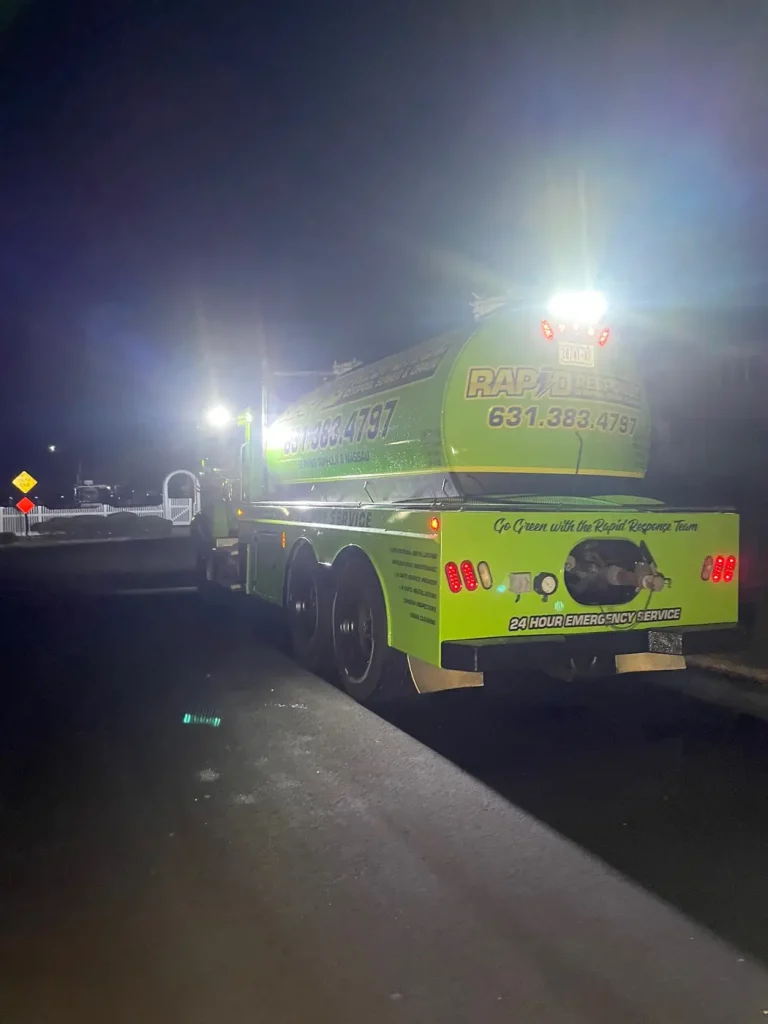
Rapid Response Cesspool serves all of Nassau and Suffolk County, 24 hours a day, 7 days a week, including holidays. Call . We’ll tell you what to do while we’re on the way and give you an honest estimate when we arrive.
Step 4: Don’t Use Chemical Drain Openers
Drano, Liquid-Plumr, and similar products are designed for individual drain clogs — not cesspool backups. Pouring them into a backed-up drain won’t fix the problem and can damage your pipes and kill the beneficial bacteria the cesspool needs to function. Skip it.
Step 5: Don’t Try to Locate or Open the Cesspool Yourself
Cesspool lids can be heavy, brittle, or submerged just below grade. Open cesspool access points are fall hazards — for you, your kids, and your pets. Leave it to the technician with the right equipment.
What Causes Cesspool Backups?
The most common causes of sudden backups on Long Island:
- Full tank — the cesspool hasn’t been pumped in too long and has no more capacity
- Blocked inlet pipe — tree roots, grease buildup, or a collapsed pipe between the house and the tank
- Failed leaching pool — the tank has capacity but can’t drain into the surrounding soil
- Heavy rain — saturated ground can back up into cesspools, especially on South Shore Long Island
In most cases, an emergency pump-out provides immediate relief. The technician will then assess the system and tell you if there’s an underlying problem that needs to be addressed.
After the Pump-Out
Once the system is pumped, the immediate backup should resolve. If drains are still slow, the issue may be a blocked pipe or a failing leaching field — not the tank capacity itself. Have the technician run a diagnosis before you assume the system needs replacement.
Clean any affected areas with a disinfectant. Wash anything that came into contact with sewage. If there was significant floor flooding, consider calling a water damage restoration company in addition to the cesspool service.
We’re Available Right Now
Rapid Response Cesspool handles emergency backups across Bay Shore, Islip, Babylon, Huntington, Hempstead, and all of Long Island. We answer the phone 24/7 — not an answering service, an actual dispatcher who can get a truck moving.
Call now.